
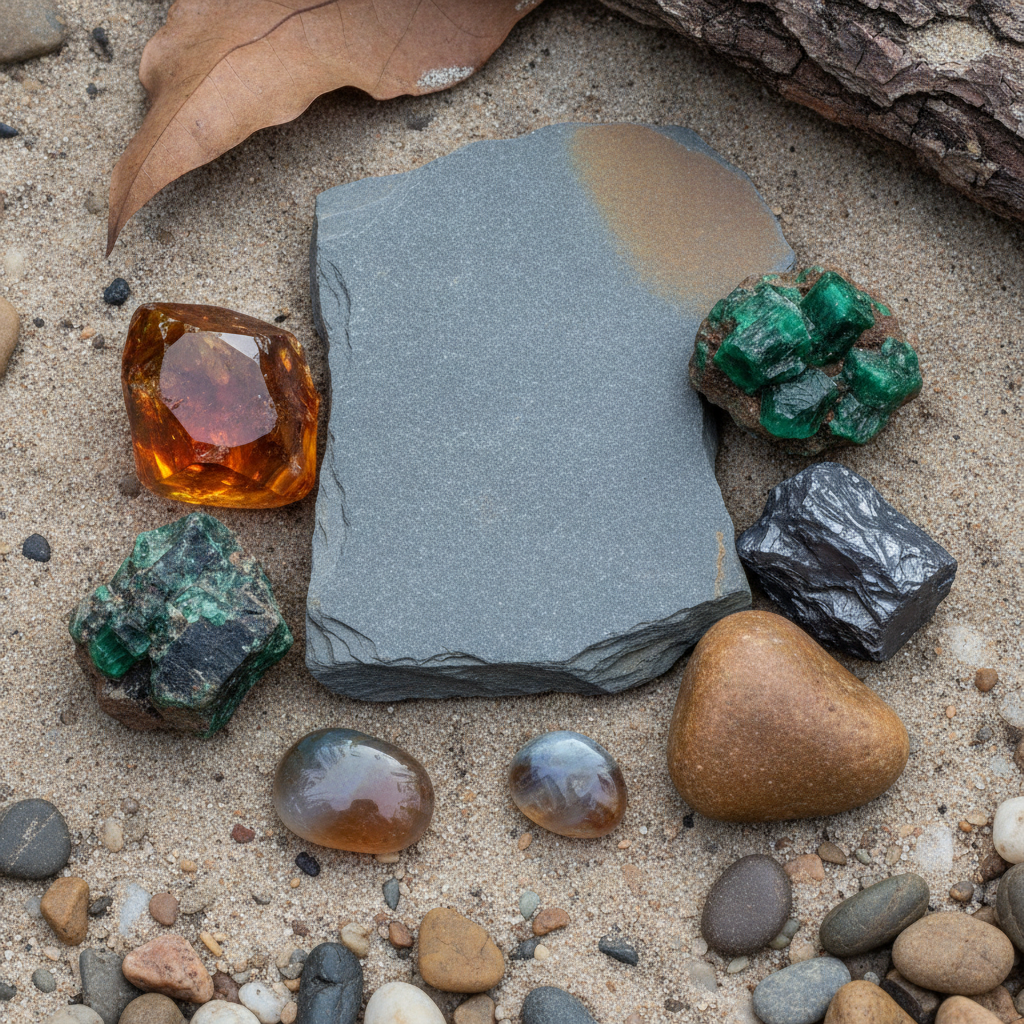
A gemstone identifier app answers a different question from a general rock scanner. The stone is often already cut. The crystal faces that would have identified it are gone. The color may have been heated, oiled, dyed, or placed over a foil backing. You still want a defensible name: ruby or garnet, emerald or glass, turquoise or dyed howlite, diamond or something cut to look like diamond. This guide explains what a phone can contribute, how to photograph gems so the answer is about the stone and not the reflection, and where you must stop claiming certainty.
Rock Identifier: Find Stone includes gemstones alongside rocks and minerals. Used on a cut gem, it is a screening step. It proposes species that match the image. It does not measure refractive index, and it does not know what a treatment lab did to the stone before it was set.
What "identified" should mean for a gem
Collectors mix up three levels of naming, and apps make the mix-up easier because they print one confident label.
Species or group. Corundum, beryl, quartz, garnet, feldspar, chalcedony. This is the level a good photo plus one physical clue can often reach. "This red stone is consistent with garnet, not glass" is a useful sentence.
Variety. Ruby, sapphire, emerald, amethyst, citrine, aquamarine. Variety is the species plus a color tradition. Ruby is red corundum. If the species is still in doubt, the variety name is premature. An app that says "ruby" has usually decided both steps at once. Make it show its work by asking what else red and transparent could be.
Trade grade and treatment. "Natural untreated Burmese ruby" is not a photo category. Heat, oil, dye, diffusion, fracture filling, and assembled stones (doublets and triplets) change value by multiples. A gemstone identifier app can hint that a stone looks like a doublet when the side view shows a glue line. It cannot certify that no treatment exists.
Write your notes at the level you actually earned. Upgrading the sentence later is fine. Starting with the most expensive sentence is how people overpay.
Photographing gems so reflections are not the subject
Cut gems are mirrors. A random phone snapshot often records the ceiling light, your shirt, and a blue window, then the app names whatever color those reflections averaged out to. Use a setup you can repeat at a kitchen table.
Kill the clutter behind the stone. A plain white or light gray card works for light gems. A mid-gray card works better for colorless stones, because a pure white background blows out the facet edges. Do not shoot on a patterned tablecloth.
Move the light, not the saturation slider. One diffused window is enough. Hold the phone so you are not blocking that window. If every facet is a white hole, you are reflecting the light straight into the lens. Tilt the gem a few degrees until you see body color inside the stone, not a lamp.
Shoot three frames.
- Face-up, filling the frame, focused on the table (the large top facet) or on the dome of a cabochon.
- A side or girdle view. This is the frame that reveals doublets, thin opal slices in a triplet, foil backs, and dyed pavé where color sits in the cracks.
- The setting or the rough back, if there is one. Closed-back antique settings hide foil. You want that on record even if the app never sees it.
Use the highest optical zoom you can hold still, or move the phone closer. Digital zoom crops after the fact and does not add facet detail. Brace your wrist on the table. Gem photos fail more often from motion blur than from wrong color.
Turn off beauty filters and portrait mode. They soften facet junctions, and those junctions are evidence. Glass and molded cubic zirconia sometimes show rounded, seam-like edges. A natural diamond's edges look sharper. A filter erases the comparison.
For rough gem crystals, shoot the termination and a broken end. A quartz point with a six-sided prism is a different problem from a tumbled amethyst pebble. Include both if you have them. Rock Identifier does better when the crystal habit is actually in the picture.
If the stone is smaller than a pea, expect lower confidence. Fill the frame as well as you can, and do not crop so tightly that the app receives a blurry color field with no outline.
Reading a gem result without inflating it
Open the top three names, not only the first. For a saturated red stone the honest set is often ruby, red spinel, and garnet. Those are different minerals: corundum at Mohs 9, spinel at 8, and the garnet group mostly between about 6.5 and 7.5. The app has clustered them because color and transparency overlap. Your next move depends on whether you may test the stone.
On rough or already chipped material, a glass plate tells you something. Anything at or above quartz hardness, 7, scratches ordinary window glass. Garnet usually will. Glass gems usually will not. Corundum and spinel both will, so the glass test does not separate ruby from spinel. It does pull glass and softer simulants off the list. Never do this on a polished crown facet.
On a finished jewel, put the phone down and pick up a 10× loupe. You are looking for a short list of visible facts:
- Bubbles, especially round ones, suggest glass or a filled cavity.
- Swirls suggest glass.
- A flat glue plane or a sudden change in luster along the girdle suggests an assembled stone.
- Color concentrated in fractures suggests dye.
- Perfectly even color and no inclusions do not prove a fake, but in emerald they are unusual enough to slow you down.
- Doubling of pavilion facet edges, seen through the table, suggests a doubly refractive stone. Garnet and spinel are singly refractive and will not show that doubling. Tourmaline and corundum can. This is a loupe skill, not an app skill, and it takes practice. If you cannot see it, do not invent it.
Rock Identifier's property notes are there so you can check the story. If the result says quartz and the stone shows strong fire like a diamond, the photo and the name are in conflict. Reshoot the side view before you accept quartz. If the result says turquoise and the side view shows a plastic sheen and mold lines, believe the side view.
Faceted stones, cabochons, and rough crystals are three different jobs
Faceted transparent gems hide behind their own brilliance. Body color matters more than sparkle. Tilt until you see it. Species-level guesses from this kind of photo are provisional whenever the hardness neighbors are close. Diamond, moissanite, cubic zirconia, white sapphire, and colorless topaz can all be presented as a "diamond-like" picture. A gemstone identifier app should put diamond on a short list, not close a sale. Moissanite in particular is sold specifically because it passes a casual glance and even some older diamond testers that only checked thermal conductivity. If the price is a diamond price, the tester and the seller need to be specific about moissanite, and you want that in writing.
Cabochons are domed, polished, and usually translucent or opaque: turquoise, moonstone, star ruby, opal, jade, agate. The dome hides inclusions and shows color and pattern instead. Pattern is useful. Eye-like bands point toward malachite or agate. A floating blue sheen on a colorless dome points toward moonstone. A moving six-ray star points toward oriented inclusions in corundum or, sometimes, a painted or assembled imitation. Opal needs a tilt video more than a still photo. Play-of-color moves. Glitter glued inside resin often sits at one depth and looks coarse. Shoot the side so a triplet's cap and backing are visible.
Rough crystals are where an app and a field test agree most often. You still have habit, cleavage, and sometimes streak. Emerald crystals are typically prismatic and included. Garnet is commonly equant. Amethyst often lines the inside of a geode rather than forming a single jewelry crystal. Photograph the crystal in place in the geode and as a single point if one is loose. Rock Identifier can name the mineral. The pocket in the geode tells you the variety context, such as amethyst versus a dyed geode section. Dyed geodes are common in décor shops. The color sits in a band near the surface or looks unnaturally vivid against a gray agate lining. Say so in your note.
Treatments the camera cannot certify
Knowing the names of treatments keeps you from asking the app to do a lab's job.
Heat is routine for citrine made from amethyst, for many blue sapphires, and for tanzanite. Heat does not always leave a photo clue. A heated stone can still be the species the app named. The missing information is the word "heated" on a disclosure, which changes price, not the basic identification.
Oil and resin in emerald fill the fractures that most emeralds have. A freshly oiled emerald looks cleaner. A dried-out one looks suddenly included. The species is still beryl. An app will not tell you the filler type. A jeweler can often see residue. A report states it.
Dye is the main issue in chalcedony, howlite sold as turquoise, and some jade. Side light and a loupe beat another scan. Color that follows cracks is a clue. Acetone on a cotton swab is a clue on a sacrificial surface only. Do not soak a finished piece.
Diffusion and surface color add color to a thin outer layer of some corundum. Recutting the stone changes the color. You will not see the diffusion layer in a phone photo of a set ring. If a sapphire's color looks oddly confined and the price is far below a comparable stone, ask directly whether it is diffusion treated. The app's "sapphire" label can still be mineralogically fair while the value is not.
Fracture-filled and lead-glass rubies are built from low-grade corundum plus a glass filler. They can look red and shiny. Under a loupe, bubbles in the filled cracks are a known warning. These stones are fragile to heat and to some jewelry repair. "Ruby" as a species word becomes misleading in the trade if the product is mostly glass by volume. A gemstone identifier app may say ruby because the red corundum is what the surface resembles. Your note should say "possible lead-glass composite — needs a loupe before any price."
Assembled opals, garnets, and doublets put a real slice on a cheaper base. The side photo is mandatory. Once you have seen a dark line around the girdle, you cannot honestly list the stone as a solid gem of the top material.
A comparison table for the gems people ask apps about
Use this after the scan, not instead of looking at the stone. Hardness is Mohs. "Phone cue" means something a careful photo or a 10× loupe might show. It is not a guarantee.
| Claimed gem | Often actually | Hardness contrast | Phone or loupe cue |
|---|---|---|---|
| Diamond | Moissanite, cubic zirconia, white sapphire, glass | Diamond 10; moissanite ~9.25; CZ ~8–8.5; sapphire 9; glass ~5–6 | Doubling and a specific electrical meter point to moissanite. Bubbles and soft facet edges point to glass. A photo of facet sparkle does not decide. |
| Ruby | Spinel, garnet, red glass, lead-glass composite | Corundum 9; spinel 8; garnet ~6.5–7.5; glass softer | Bubbles in cracks suggest filler or glass. Garnet usually shows less color shift when turned than ruby. |
| Emerald | Green glass, chrome diopside, green tourmaline, peridot | Beryl 7.5–8; diopside 5.5–6; tourmaline 7–7.5; peridot 6.5–7 | Too-clean color is a warning for glass. Olive hue favors peridot. Diopside is softer if you are allowed to test rough. |
| Amethyst | Purple fluorite, dyed agate, glass | Quartz 7; fluorite 4 | Fluorite cleaves into flat octahedral chips. Quartz breaks with a curved fracture. Dye sits in agate bands. |
| Turquoise | Dyed howlite or magnesite, chrysocolla, plastic | Turquoise 5–6; chrysocolla 2–4 | Plastic is light. Dye can wipe onto acetone from a broken edge. Chrysocolla looks more glassy in pores. |
| Jade | Serpentine, aventurine, dyed quartz | Jadeite 6.5–7; nephrite 6–6.5; serpentine often 2.5–5.5 | Serpentine scratches more easily on a discreet underside. Aventurine shows sparkly mica flakes. |
| Opal | Resin, glass, doublet or triplet | Opal 5.5–6.5 | Side-on layers reveal assembled stones. Play-of-color should move as a sheet of spectral color, not as loose glitter. |
| Moonstone | Milky chalcedony, glass | Feldspar ~6–6.5; chalcedony ~6.5–7 | Moonstone's blue sheen floats and moves. Glass can imitate it with a molded sheen that looks painted. |
The table is a restraint. If your stone is in the left column only because a tag said so, the middle column is the list you still have to clear. Rock Identifier belongs at the moment you fill in the left column from a photo instead of from the tag.
A worked session: a red stone in a gold-colored ring
The ring comes from a relative's drawer. There is no paperwork. The stone is oval, faceted, and a bright red that looks slightly brownish indoors. You shoot a face photo and a girdle photo in window light. Rock Identifier returns ruby first, garnet second.
The girdle photo shows a single material, not an obvious doublet. Under a loupe you do not see bubbles or a glass-filled web of cracks. You do see a few angular inclusions and, when you tilt the stone, a modest color change rather than a dramatic one. That does not prove garnet, and it does not prove ruby. It does make lead-glass composite less likely than it was before you looked. Hardness is off limits because the stone is set and polished. The correct note is: "Red faceted stone. App short list ruby (corundum) or garnet. No obvious filler under 10×. Species not resolved. Do not price as ruby."
That session is a success. A gemstone identifier app narrowed the language. The loupe removed one expensive mistake. The unresolved pair is exactly the pair a refractometer is for. You can take the ring to a jeweler with a better question than "what is this?"
A second stone, a sky-blue cabochon bought as turquoise, shows color pooling in fine cracks on the side photo. The app says turquoise, with a lower-ranked chalcedony suggestion. The crack pattern plus a slightly chalky white patch where the cabochon is chipped fits dyed pale stone better than dense turquoise. You do not need to acetone-test a good surface. The chip already told you the color is not uniform through the material. The label becomes "dyed unknown, turquoise color," which is the honest one.
Jewelry settings, lighting, and false color
The mounting changes the photo. A closed back with yellow foil warms every colorless stone and can make glass look like a period gem. Note "foil back possible" when you cannot see through the pavilion. Rose gold reflects pink into a pale stone. A photo taken in a red velvet box will stain the color balance. Take the piece out of the box.
Mixed lighting is worse than dim lighting. A window plus a warm bulb makes amethyst look gray in one corner and pink in another. Pick one. Flash from the phone flattens cabochons and blows out facets. Use it only as a last try for a dark stone, and take a second frame without it.
Size references matter for your notes and not for the model. A 2-millimeter melee will not identify like a 2-carat center. Say which stone you photographed when a piece has several colors. Scanning a whole "birthstone" bracelet produces a nonsense average.
Privacy, value, and what not to post
Gem photos are ordinary objects, but a post that says "is this a real ruby?" under your real name, with a distinctive ring, is a map to your house. Crop out engraved names if you are sharing the image for advice. Do not send high-value pieces to strangers who offer to "test them properly" by mail based on an app screenshot.
Insurance riders want appraisals, not app screenshots. You can attach the screenshot to your own file as a starting note. The document that matters is the one signed by an appraiser who stated the species, treatments they could or could not rule out, carat weight, and a value for a stated purpose. Those are different jobs. A gemstone identifier app does not become an appraisal because the screen looks official.
A repeatable gem routine
- Remove the piece from colored boxes and photograph face and side in one kind of daylight.
- Scan the face photo in Rock Identifier and write down three names, not one.
- Check the side photo for layers, dye in cracks, and foil.
- Loupe the stone for bubbles and filler before you talk about price.
- Only hardness-test rough, chipped, or nearly worthless material, and only to settle a specific pair from the table.
- If diamond, ruby, emerald, jade, or a large opal is still on the list and money is involved, book a human test.
Follow that order and the app stays in its lane. It is good at proposing species from a clean image of color and shape. It is bad at vanity metrics and at seeing through a deliberately reflective cut. The people who get the most from a gemstone identifier app are the ones who write the uncertainty down.
Frequently Asked Questions
Can a gemstone identifier app tell diamond from moissanite?
Not reliably from a sparkle photo. Both are hard, colorless, and cut to look brilliant. Moissanite has to be on your list whenever an app says diamond. A tester used by someone who knows moissanite's electrical behavior, or a lab, is the step that finishes the job.
Are cabochons easier to identify than faceted gems?
Often yes, because you see body color and pattern instead of a mirror. They are harder when the material is opaque and commonly dyed, which is the turquoise and jade problem. Always add a side photo.
Should I clean a gem before I scan it?
Wipe off skin oil and lotion with a soft dry cloth. Do not ultrasonic-clean, steam, or soak opal, emerald, turquoise, or anything with a foil back. Dirt in a crack is useful evidence. Aggressive cleaning can remove oil from emerald or lift dye.
Why did the app call my heat-treated citrine "amethyst"?
Heated amethyst becomes yellow and is sold as citrine, but a pale or oddly zoned stone can still read as amethyst. Both names are quartz. Check hardness only if the piece is rough. If it scratches like quartz, the open question is color treatment, not species.
Can the app price my jewelry?
No. Species is one input to price. Weight, clarity, cut, treatment, and the market are the others. Use the identification to ask a better pricing question. Use an appraiser when you need a number for insurance or sale.
Is Rock Identifier only for rough rocks?
No. It is useful on cut gems when you treat the result as a short list and you photograph the side of the stone as well as the crown. Rough crystals give it more habit and breakage clues, so confidence is usually higher there.
Download Rock Identifier Today
Before you rename a ring from a family story, photograph it properly and get a short list. Rock Identifier: Find Stone covers gems, crystals, and minerals so the first name you write down is a hypothesis you can check with a loupe, a side view, and the lookalikes that actually match that color.
Download Rock Identifier on the App Store and identify the gem you have, not the gem the tag hoped for.